Cost to Build a House in Malaysia 2026: Real Prices Per Square Foot
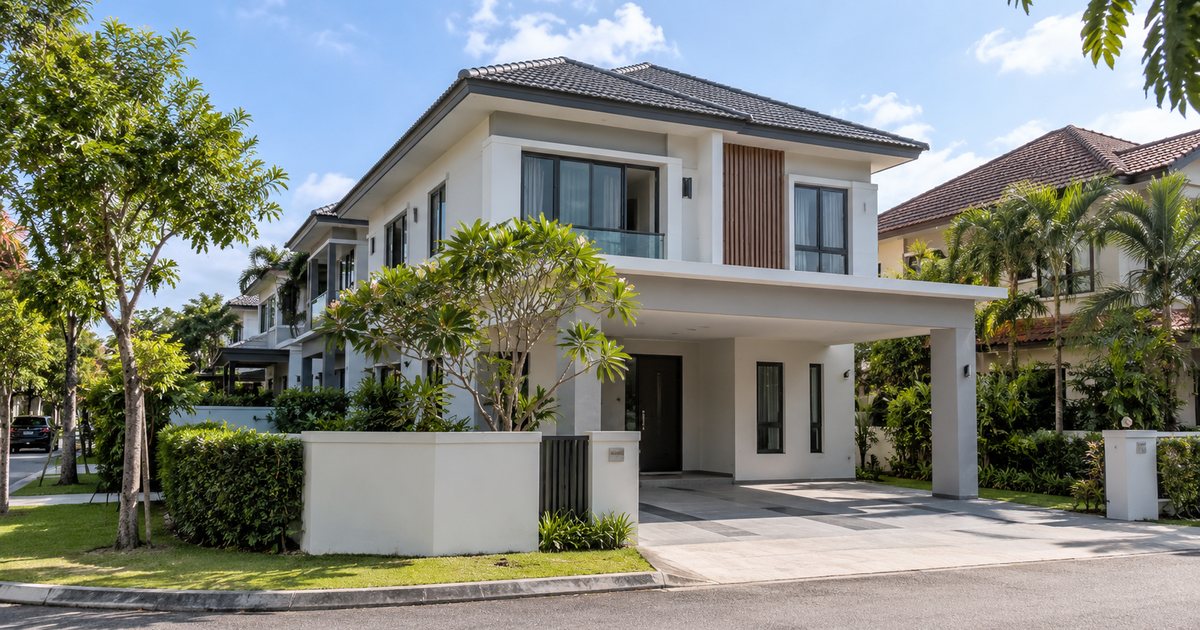
Planning to build on your own land? In 2026, construction costs in Malaysia run between RM180 and RM350+ per square foot depending on specification, location and number of storeys. Here's the full breakdown, based on live market rates used by our estimating engine.
2026 cost per square foot by specification
| Specification | Cost / ft² | 1,000 ft² example |
|---|---|---|
| Basic — standard finishes, metal deck roof | RM180 – RM230 | RM180k – RM230k |
| Standard — porcelain tiles, concrete roof tiles | RM250 – RM330 | RM250k – RM330k |
| Premium — imported finishes, high ceilings | RM350 – RM450+ | RM350k – RM450k+ |
Real reference point: a full estimate generated by Wakkiro for a standard-spec 1,000 ft² single-storey house in Selangor comes to about RM264,000 including site preliminaries, insurances and statutory contributions (CIDB levy, JKKP) — excluding land and consultant fees.
Where the money goes
- Structure & groundworks (35–45%) — foundations/piling, ground slab, columns, beams
- Roofing & ceilings (8–12%)
- Brickwork & plastering (10–14%)
- Finishes (12–18%) — floor/wall tiles, full paint system, doors & windows
- M&E (10–15%) — electrical wiring, plumbing, sanitary ware, drainage
- Preliminaries & statutory (8–12%) — insurances, levies, permits, site facilities
Worked example: standard 1,000 ft² single-storey in Selangor (~RM264,000)
Here's roughly how that RM264,000 estimate splits by trade, so you can sanity-check any builder's quotation against it:
| Trade section | Approx. amount | Share |
|---|---|---|
| Piling, foundations & ground slab | RM55,000 – RM65,000 | ~23% |
| Concrete frame — columns, beams, lintols | RM38,000 – RM45,000 | ~16% |
| Roof trusses, covering & ceilings | RM24,000 – RM30,000 | ~10% |
| Brickwork & plastering | RM28,000 – RM34,000 | ~12% |
| Floor & wall finishes, painting | RM32,000 – RM40,000 | ~14% |
| Doors, windows & ironmongery | RM15,000 – RM20,000 | ~7% |
| Electrical, plumbing & sanitary | RM28,000 – RM36,000 | ~12% |
| Preliminaries, insurances, CIDB levy | RM18,000 – RM26,000 | ~8% |
The build process, step by step
- Confirm the land can be built on — title category (residential), land conversion if needed, and access to road, TNB supply and water. Sort this before paying any consultant.
- Soil investigation — a basic mackintosh probe/borehole test costs RM1.5k–RM5k and decides whether you need RC piles or can sit on pad footings. Skipping it is false economy.
- Appoint architect/engineer and submit building plans — your PBT requires submissions by registered professionals. Approval typically takes 2–6 months.
- Tender to 2–3 CIDB-registered contractors — G1 covers works up to RM200k, G2 up to RM500k. Price them against the same BOQ, not against a one-line description.
- Sign a proper contract — with a payment schedule tied to milestones, a defects liability period (6–12 months) and 5% retention.
- Construction (8–16 months) — foundation → structure → roof → M&E first fix → plaster & finishes → M&E second fix → external works.
- CCC (Certificate of Completion and Compliance) — issued by your principal submitting person once all Form Gs are collected. No CCC, no legal occupation.
Enter your built-up area, storeys and state. Wakkiro generates a full bill of quantities with current market rates in 2 minutes. No drawing needed. Free.
Estimate My House →What moves the price
Location
Selangor/KL rates are the benchmark; Johor is similar; rural areas save 5–10% on labour but add material transport. Each state has its own labour and material rate profile.
Soil conditions
Soft soil means longer piles — easily RM15k–RM40k extra on a typical house. Always budget for a soil test before committing.
Labour mix
Local vs foreign labour composition shifts the final price by 3–8%. Wakkiro's estimates show scenario A (mixed), B (local) and C (foreign) side by side so you can see the realistic range before negotiating.
Hidden costs first-time builders forget
- Consultant fees — architect/engineer/drawings: 3–8% of construction cost
- Utility connections — TNB and water deposits and connections: RM3k–RM8k
- Contingency — keep at least 10% for variations and site surprises
- External works — fencing, car porch, driveway, drainage, landscaping
Standard vs premium: where upgrading actually costs you
- Floor tiles — local porcelain 600×600 at RM3–RM6/ft² material vs imported large-format at RM12–RM25/ft². On 1,000 ft² that's a RM10k–RM20k swing on one line.
- Roof — metal deck with insulation vs clay tiles roughly doubles the roofing package.
- Ceiling height — going from 10 ft to 12 ft adds brickwork, plaster, paint and longer columns: typically 3–5% on the structure and architecture trades.
- Kitchen and wardrobes — usually excluded from construction cost entirely. Budget RM15k–RM60k separately.
- Autogates, air-cond piping, solar-ready wiring — cheap to rough-in during construction, expensive to retrofit.
Common mistakes first-time builders make
- Signing a lump-sum quote with no quantities — you cannot compare or verify it. Insist on a BOQ (here's how to read one).
- Paying deposits ahead of work — 10–15% on signing is normal; anything above 25% before the foundation is poured is a red flag.
- No retention sum — keep 5% until the defects liability period ends, or you'll chase the contractor for cracked plaster with no leverage.
- Changing the design mid-build — variation orders are priced at the contractor's mercy. Freeze the design before tender.
- Ignoring statutory items — CIDB levy (0.125% of contract sum above RM500k), JKKP notifications and workman insurance are real costs someone must carry; make the quote say who.
A sensible payment schedule
| Milestone | Payment |
|---|---|
| On signing (mobilisation) | 10 – 15% |
| Foundation & ground slab complete | 20% |
| Structure & roof on | 25% |
| Plastering, M&E first fix done | 20% |
| Finishes complete, testing done | 15 – 20% |
| Retention — released after defects period | 5% |
If you're financing the build, this maps neatly onto bank construction-loan drawdowns — banks release progressively against architect's certificates, and LPPSA's build-on-own-land scheme for civil servants works the same way.
FAQ
How long does construction take?
A typical single-storey house: 8–12 months including local authority approval. Double-storey: 12–16 months.
Can I get financing to build on my own land?
Yes — commercial banks offer construction loans with progressive drawdowns, and LPPSA has a dedicated scheme for civil servants. Both require approved plans and a contractor agreement.
What CIDB grade of contractor do I need?
G1 (up to RM200k) or G2 (up to RM500k) covers most single houses. Always verify the registration number on CIDB's online portal — an unregistered builder voids your legal protections and complicates CCC issuance.
Does a double-storey house cost double per square foot?
No — per ft² it's often slightly cheaper, because one foundation and one roof serve two floors of area. Absolute cost is higher, though, and the first-floor slab, staircase and scaffolding add their own line items.
Should I be my own main contractor to save money?
Self-managing subcontractors can save 10–15% but transfers all coordination risk to you: sequencing trades, material buying, wastage and quality control. If you can't be on site several times a week, appoint a main contractor and keep the retention sum instead.
What does the RM per ft² figure exclude?
Typically: land, consultant fees (3–8%), kitchen cabinets and wardrobes, air-conditioning units, fencing/landscaping beyond basics, and utility deposits. Ask every builder to list exclusions in writing — that's where "cheap" quotes hide.
When is the best time to lock in prices?
Sign a fixed-price contract once drawings are frozen. Material prices (steel, cement, tiles) move during the year; a fixed lump-sum contract with a defined BOQ transfers that risk to the contractor instead of you.
Three questions, two minutes. Quantities, current rates and a construction timeline.
Start Now — Free →Related: Cost to Build a Bungalow in Malaysia 2026: Price per sq ft, Real Projects and a Full Budget