Why Renovating a Shoplot or Heritage Property in Malaysia Costs More Than It Looks
A shoplot or colonial-era heritage unit often looks like a smaller renovation job than a full house. Sometimes it is literally a smaller floor area. But the cost per square foot on these projects regularly runs higher than a standard home renovation, and the reasons are specific enough that a standard cost estimate usually misses them.
Here are the specific cost drivers behind older buildings, why shoplots and heritage units are a category of their own, and how to budget for one honestly.
Why does structural condition drive shoplot renovation cost?
Older shoplots, especially colonial-era or early post-independence units like those common along the older commercial streets of Johor Bahru and other Malaysian towns, were often built with materials and structural standards that do not meet current building code. Timber floor joists, ageing brick walls, and foundations never designed for today's loads are common.
Before any renovation work can properly begin, a structural assessment is usually needed. Reinforcement, such as extra steel bracing, new footings and wall strengthening, is one of the largest and most unpredictable line items in this category of project.
Unlike a new build, where structural cost is fairly predictable from the drawings, here it depends heavily on the actual condition behind the walls, which often is not fully known until work has started.
Do heritage zone rules really add to the cost?
Yes. If a property sits within a designated heritage zone or conservation area, local authority approval processes can require preserving specific facade elements, using particular materials, or following restoration guidelines rather than standard renovation practice.
This is not just a paperwork delay. It directly affects cost:
- Heritage-appropriate materials and specialist restoration work typically cost more than standard modern equivalents.
- The approval process itself can extend project timelines, which carries its own cost in financing and holding costs.
Will an old shoplot need full rewiring and replumbing?
Often, yes. Electrical wiring and plumbing in older shoplots frequently do not meet current safety standards and were never designed for modern loads: additional aircon units, more outlets, updated water pressure needs.
In many cases this means a full rewire and replumbing rather than a partial upgrade. It is a cost category that is often underestimated because it is not visible until walls are opened up. For a sense of how wiring is priced, see our guide to house wiring costs (in Malay).
How do party walls complicate a shoplot renovation?
Shoplots are frequently attached to neighbouring units through shared party walls. Any structural work affecting a shared wall can require coordination, and sometimes formal agreement, with the neighbouring property owner.
That adds both cost and timeline uncertainty that a standalone house renovation simply does not have to deal with.
Upload a drawing or describe the job — Wakkiro builds an itemised BOQ at current Malaysian rates, free.
Estimate My Project →Why does a standard renovation estimate undercount shoplots?
A typical residential cost benchmark assumes standard structural condition, standard utilities, and no heritage restrictions. Applying that benchmark directly to a shoplot or heritage renovation tends to significantly understate the real cost.
That is not because the benchmark is wrong, but because it was not built for this category of building in the first place. Figures from a general renovation cost guide are a useful starting point for finishes and fixtures, but not for the structure and services of an older shoplot.
How should you budget for a shoplot or heritage renovation?
Building in a genuine contingency, often higher than the standard 10% used for new builds, is standard practice for this category, precisely because structural surprises are the norm rather than the exception.
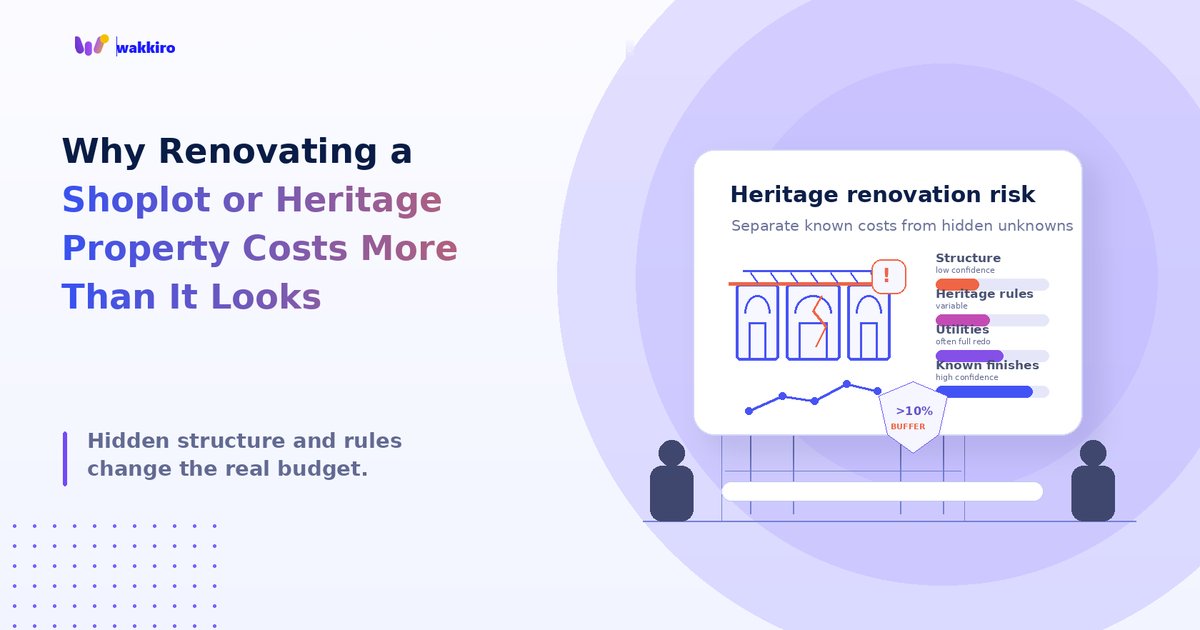
A proper cost breakdown for this kind of project needs to separate:
- What is confidently known: finishes and fixtures.
- What is genuinely uncertain until walls are opened: structural condition and hidden utility issues.
That way the budget reflects the uncertainty honestly rather than presenting a single confident number for a project that inherently carries more risk. Knowing how to read a BOQ helps you spot which items in a quotation fall into each group.
Where does Wakkiro fit into this?
The core challenge with a shoplot or heritage renovation is not just that costs run higher. It is that so much of the cost is genuinely uncertain until work begins.
A Wakkiro-generated BOQ handles this the way it is meant to be handled. Confidently known items, such as finishes and standard fixtures, are quantified and priced with high confidence, while items that depend on conditions not yet visible, such as structural extent and hidden wiring runs, are flagged with a lower confidence score rather than presented as a fixed number.
Instead of a single lump-sum figure that either overstates certainty or gets padded with an arbitrary buffer, you get a breakdown that separates what is solid from what genuinely needs on-site verification. Upload the drawing or basic project details and see exactly where the real risk in the budget sits, before signing anything.
Frequently Asked Questions
Why is renovating a shoplot more expensive per square foot than a house?
Older shoplots often need structural reinforcement, a full rewire and replumbing, and sometimes heritage-compliant materials. These costs are rarely included in standard residential renovation benchmarks.
Do I need a structural assessment before renovating an old shoplot?
Usually, yes. Older units often have timber floor joists, ageing brick walls and foundations not designed for today's loads, so an assessment is normally needed before work can properly begin.
How much contingency should I set aside for a heritage or shoplot renovation?
Often more than the standard 10% used for new builds, because structural surprises are the norm rather than the exception in older buildings.
Does a heritage zone affect renovation cost in Malaysia?
Yes. Local authorities can require you to preserve facade elements, use particular materials or follow restoration guidelines, which typically cost more and can lengthen the approval timeline.
Do I need my neighbour's agreement to renovate a shoplot?
If structural work affects a shared party wall, it can require coordination and sometimes formal agreement with the neighbouring owner, which adds cost and timeline uncertainty.
Line-by-line BOQ for a new build, extension or renovation — in minutes.
Start Now →